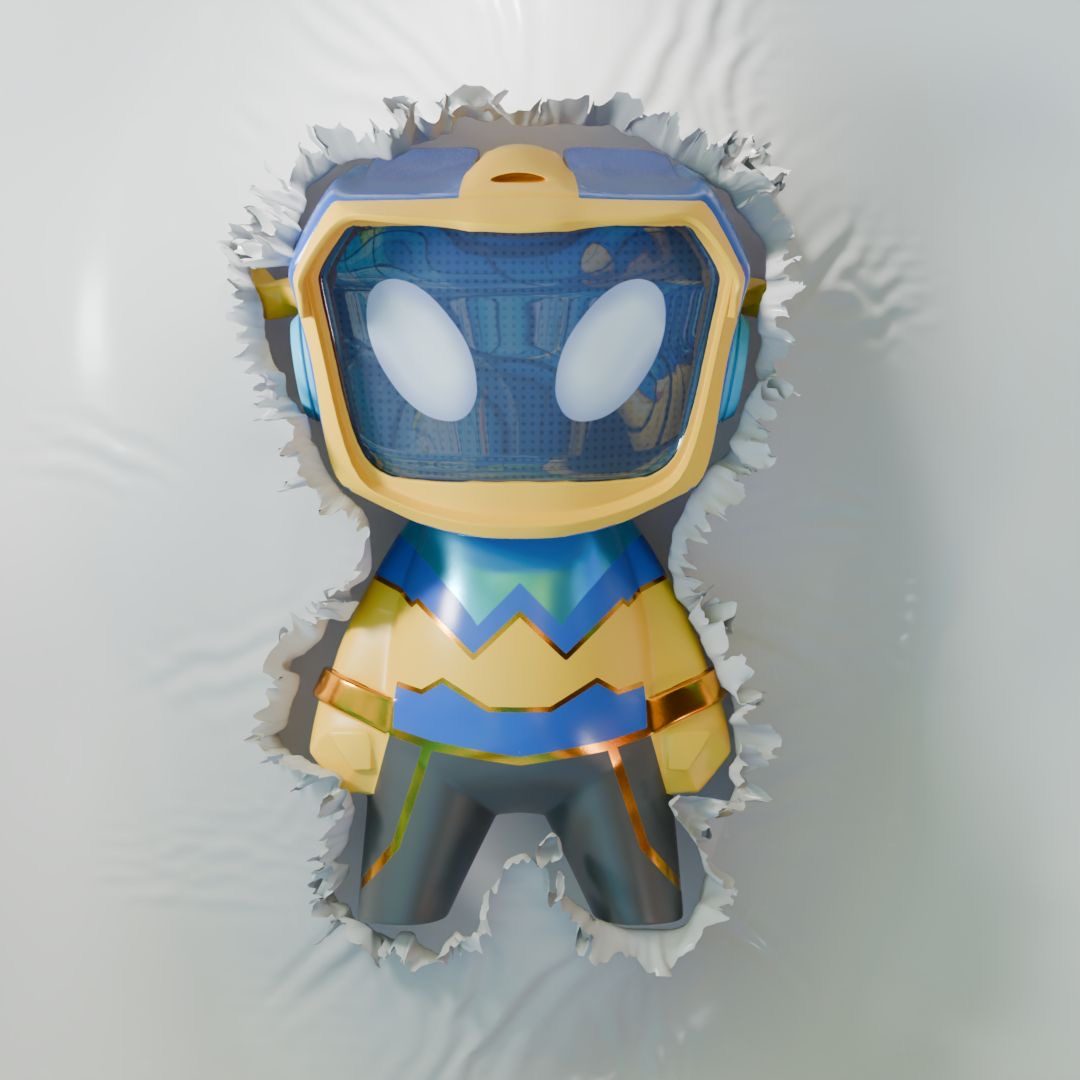
Six factories, one choice
We visited and surveyed six factories in Shenzhen before committing to one.
We went in person. We looked at finished objects rather than capability decks, because a factory's website tells you what they can quote for and a shelf tells you what they can actually deliver. The one we chose is the one whose existing work we would have been happy to have made ourselves.
Everything ships from there.
The flagship figure
Weight is the first thing a person notices and the last thing they can be argued out of. A resin figure at half a kilo does not feel like a toy. It feels like an object that was made on purpose, and that impression is formed before anyone has read a single line of the lore.
Magnets, twice
The base attaches magnetically. The figure lifts off cleanly and sits back exactly where it belongs. No screw thread, no peg, no glue, no ring of adhesive residue two years later.
The ears attach magnetically. They are moulded in ABS rather than resin and ship separated from the body.
The second decision is doing more work than it looks like. Protruding parts are the single most common casualty in international shipping, and they are the reason a lot of designer figures arrive damaged. Shipping the ears flat and separate removes the failure point entirely. The collector attaches them in about two seconds and the magnet does the alignment for them.
ABS for the ears because ABS survives handling that resin does not. Resin for the body because resin holds detail and carries weight. Each material is doing the job it is good at.
One hundred pieces per design
Every Blokyz figure design is produced to exactly one hundred pieces.
Not one hundred as an opening run with more to follow. One hundred, and then the design is finished.
This is a constraint we imposed on ourselves and it is the most expensive commitment in the entire operation. Short runs cost more per unit. They cap revenue per design. They mean saying no to reorders when a design sells out and the demand is obviously there.
We hold it anyway. A collectible that can be reprinted whenever it sells well is not a collectible. It is merchandise with a story attached, and the collectors who bought first are the ones who pay for the difference.
The chip
Every figure carries an NFC chip. Our vendor is Qliktag, based in the United States.
What it does. Tap the figure with a phone. The chip proves the object is authentic and identifies exactly which piece it is. Ownership can be bound to it, and rebound when the piece is sold, so the proof survives resale rather than dying with the first owner.
What it does not do. The chip proves the object is authentic. It does not prove the chip is still attached to the object it was attached to at the factory. Anyone who tells you a chip solves counterfeiting completely is selling you something. The gap is closed by tamper evident mounting, not by the chip alone, and we treat it as a mounting problem rather than a marketing claim.
Why Qliktag. The chips are highly configurable. That matters less on day one and a great deal in year three. A chip that only ever returns a certificate page is a dead end. A chip we can reconfigure is a permanent connection between a physical object on a shelf and whatever we build next, without asking the collector to buy anything new.
The first thing that connection does is put the figure's character onto the collector's map. It will not be the last.
Everything before the factory is in house
The design team is in house. Character design, era design, the five hundred and forty piece art commission, all of it directed internally.
The 3D modelling team is in house. The sculpt that becomes the mould is made by the same people who designed the character on paper. Nothing is thrown over a wall to a contract sculptor and returned as an approximation.
The animation team is in house. Every launch animation, every collaboration piece, made by our own team.
This is unusual for a brand at our size and it is a deliberate cost. It means the object on the shelf and the character in the comic and the figure in the animation are all the same character, because the same people made all three.
The production line
Design. The character is designed within the era and tribe canon, as a piece of art first.
Sculpt. The 3D team builds the figure from the art. Silhouette, weight distribution, magnet placement, and the split between resin body and ABS ears are all resolved here.
Mould and sample. Shenzhen produces samples. Nothing goes to run until a physical sample has been held and approved.
Run. One hundred pieces. Painted, assembled, chipped.
Provenance. Each piece is recorded against its source character and its edition number within the hundred.
Ship. Direct to collectors across more than twenty five countries.